VMG analysis: upwind and downwind runs with angle and VMG speed
Available for: Windsurfing, kitesurfing, wingfoiling, parawing, sailing, windfoiling, kitefoiling, landsailing
Updated on
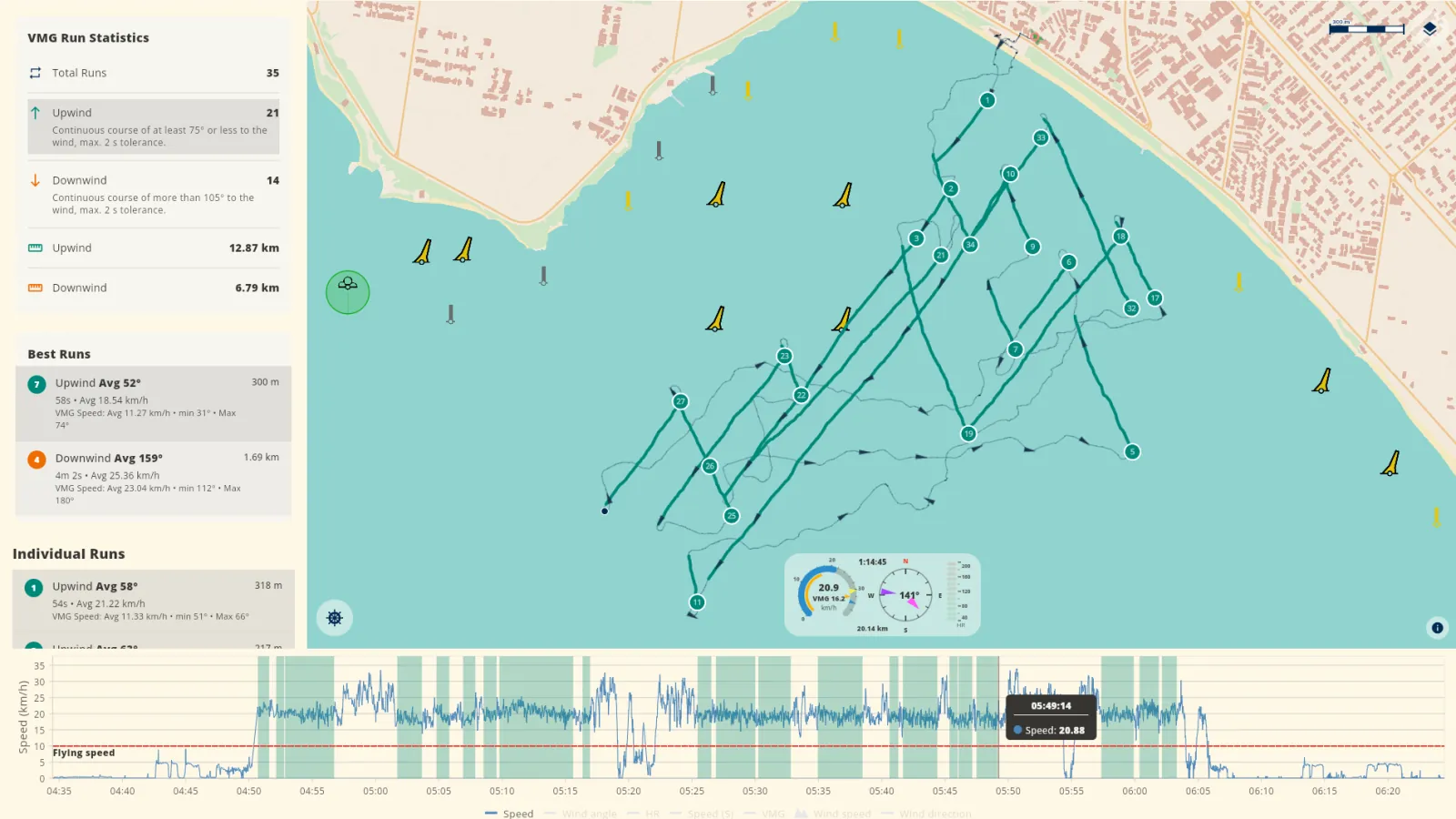
VMG (Velocity Made Good) shows how fast you go against the wind or with the wind. A high speed at a wide angle does not always get you upwind fast. A slower speed at a steeper angle can be better. WindSportTracker shows each upwind run and each downwind run of your session with its angle, its speed and its VMG. Thus, you can find the angle that works best for you.
The app also shows your VMG top speeds and a polar diagram. You can examine each run on the map and in the speed chart.
During the 27-day trial, all functions are available. You can do a test of the VMG analysis with your sessions before you buy a subscription.


What the VMG analysis shows
The VMG analysis has three parts:
- VMG runs: A list of all upwind runs and all downwind runs of the session.
- VMG top speeds: The best VMG values for time and distance, upwind and downwind.
- Polar diagram: Your VMG and speed values for each angle to the wind.
VMG runs
A VMG run is a continuous run upwind or downwind. The run stops at the point where your course is not upwind or downwind, for example at a maneuver.
For each run, the app shows these values:
- Time: The time of the run.
- Distance: The distance of the run.
- Angle: The average angle of your course to the wind.
- Average speed: Your average speed on the run.
- VMG speed: Your average speed against the wind (upwind) or with the wind (downwind).
You can sort the list by its values. Compare the angle, the average speed and the VMG speed of different runs. Thus, you can see which angle gives you the best VMG in these conditions.
Angle and speed
The steepest angle is not always the best angle. At a steep angle, your speed is usually lower. At a less steep angle, your speed can be much higher, and your VMG can be better. The best angle is different for each rider, each sport and each set of equipment.
The VMG runs show this relation for your session. If two runs have the same VMG speed, compare their angles. The run at the steeper angle goes the same distance upwind with less distance on the water.
VMG top speeds
The speed analysis has the filters VMG Up and VMG Down. These filters show the same time and distance values as the speed list, for example 10 s, 500 m or 1 h. Each value shows your best VMG for this time or distance.
The VMG top speeds also have the 5x and 10x averages. Thus, you can see if you can get a high VMG again and again.
Wind direction
The app gets the wind direction from weather data. If the wind direction at your spot was different, you can adjust it. A correct wind direction is important, because all VMG values use it.
The wind direction can change during a session. The app uses these changes. Thus, a run at the end of a long session does not use the wind direction from the start of the session.
Polar diagram
The polar diagram shows your values for each angle to the wind. It shows your VMG together with your other speed values. It also shows the course distribution: how much of the session you rode at each angle. As a wind clock, it shows on which courses you are fast and where you can do better.
Compare the polar diagrams of different sessions. You can see if your VMG upwind or downwind becomes better.
Map and speed chart
When you select a VMG run, the app shows its section on the speed-colored map. The speed chart shows the same section second by second. You can zoom the speed chart. Thus, you can see where your speed or your angle changed during the run.
Record and import
The VMG analysis is available for all sessions in the applicable sports. The device that recorded the session is not important.
- iPhone, Android, Apple Watch and Wear OS: These devices record directly with WindSportTracker.
- Garmin, Coros, Suunto and Polar: After you connect the account one time, these watches send new sessions to WindSportTracker automatically.
- Other formats: Imported sessions get the full analysis, which includes the VMG analysis.
More information about devices and import is in compatible devices.
Questions and answers
What is VMG?
VMG (Velocity Made Good) is your speed in the direction of the wind or against the wind. Upwind, VMG shows how fast you go against the wind. Downwind, VMG shows how fast you go with the wind.
Where does the wind direction come from?
The app gets the wind direction from weather data. If the wind direction at your spot was different, you can adjust it. The app also uses the changes of the wind direction during the session.
Why is the steepest angle not always the best angle?
At a steep angle to the wind, your speed is usually lower. At a less steep angle, your speed can be much higher. Thus, a less steep angle can give a better VMG.
What is the difference between VMG runs and VMG top speeds?
A VMG run is one continuous run upwind or downwind, with its time, distance, angle and speeds. VMG top speeds are the best VMG values for time and distance, for example for 10 s or 500 m.
Try the VMG analysis
During the 27-day trial, you can use the VMG analysis with your sessions. After the trial, WindSportTracker costs €2.70 each month or €27 each year when you pay in the web app. The price can be different in other currencies and because of taxes.